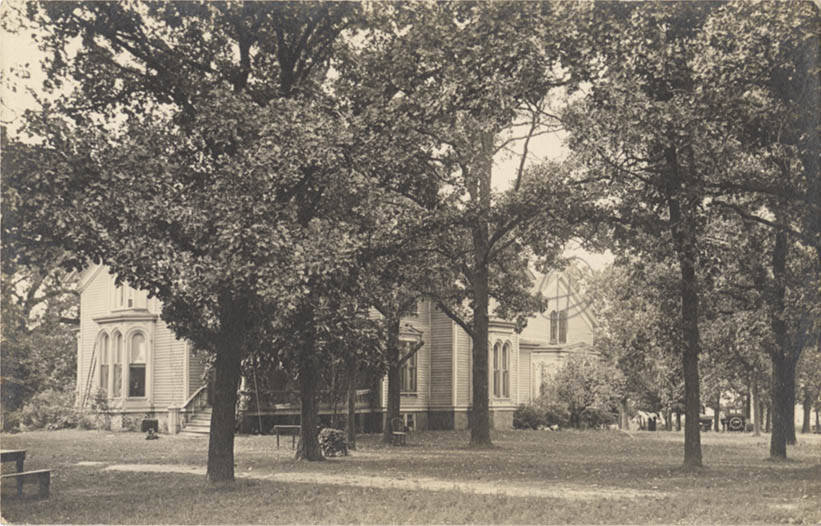
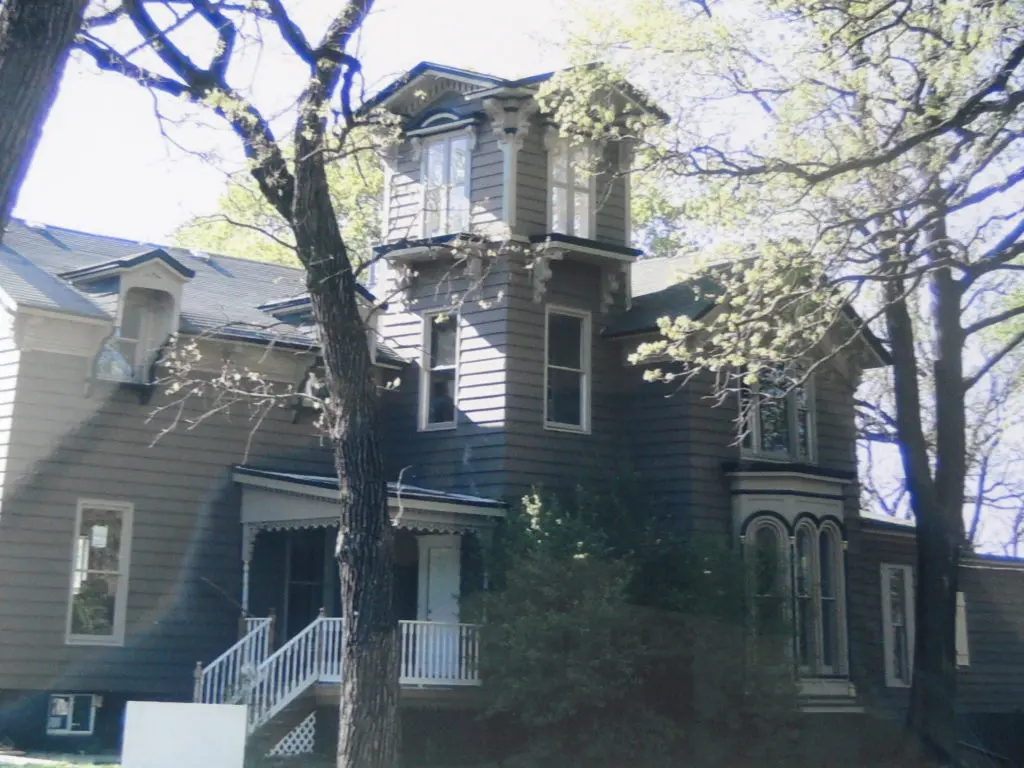
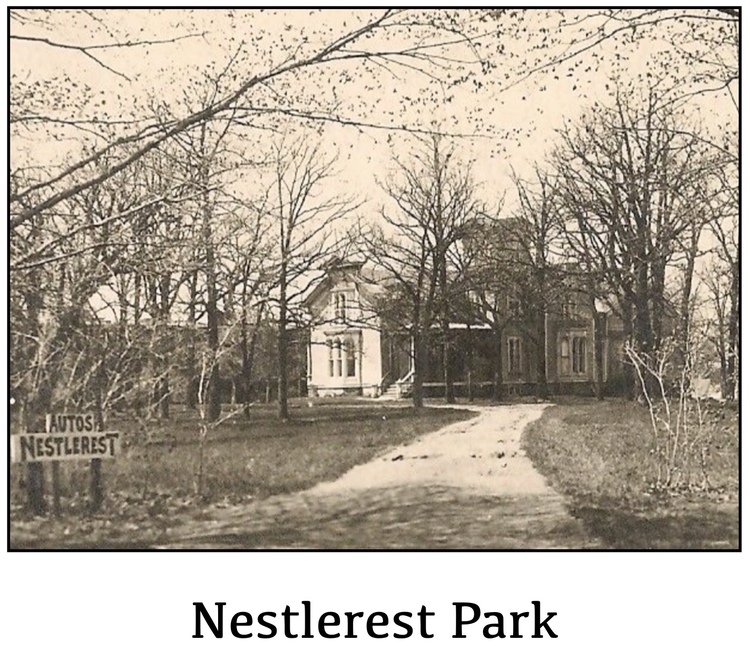
The building at 40 Mischa Court in Lake Zurich, Illinois has been standing since before the Civil War. For most of its life it was known as Nestlerest — first a lakeshore farmhouse, then a summer boarding cottage, then a public resort, and finally a beloved corporate picnic destination that entertained thousands of Chicago workers every summer for half a century. Today it is a quiet four-unit apartment building. The lake it overlooks is the same one it has always faced.
The Fox Estate, 1858–1896
Isaac Willard Fox arrived in Lake Zurich around 1858, having recently retired from the New York glass-manufacturing firm he and his brothers had operated for decades. He was thirty-six years old, experienced in both manufacturing and commerce, and came from a family with substantial industrial wealth. Within a year or two, he had established himself as one of the community's most significant landowners. By 1861, county maps labeled his name clearly on a north-south strip of lakefront land in Section 20, immediately south of Lake Zurich, between the holdings of J. C. Whiting and Jno. Robertson.[1]
The scale of the Fox holding was extraordinary for a rural lakeshore community. When legal proceedings forced a full accounting in 1875, the property was described in court documents as a 532-acre estate simply called "the Lake Zurich farm."[2] An 1918 local history of the Lake Zurich school gave the figure as approximately 600 acres and noted that "some upon which the lake now rests" — meaning Fox owned lakefront parcels that were partially submerged.[3] The same history states plainly: "Almost all of the present Lake Zurich was owned by Messrs. Fox and Robertson."
Fox did not live only at the lake. From 1865 onward he also operated a glass business in Chicago as the Chicago agent for his brothers' firm, Fox & Co., selling window glass, paints, and oils from premises on North La Salle Street. He occupied two worlds simultaneously: the farmer and landowner at Lake Zurich, the merchant and businessman in the city.[2]
In February 1865, Fox and his wife Eleanor made what would prove to be his most enduring contribution to the community. They conveyed approximately an acre of centrally located Lake Zurich land — at what is now 95 E. Main Street — to the District 13 Trustees of Schools for five dollars, for use as a schoolhouse site. The Ela Town Hall was built there that same year. It served as both a governmental center and a school until 1914, and today the site is home to the Ela Historical Society & Museum, still fulfilling the public purpose Isaac Fox placed on it more than 160 years ago.[4]
Debt, Litigation, and the Goodwin Subdivision, 1869–1900
Fox's Chicago glass business ran into serious trouble around January 1869. The First National Bank of Chicago obtained a judgment against him, his store was seized and closed, and his brothers' firm stepped in to manage the debt. On February 20, 1869, Isaac and Eleanor signed over both his La Salle Street Chicago property and the entire Lake Zurich farm as security against a $70,000 debt to Fox & Co.[2]
The debt passed from brother to brother. Samuel H. Fox held it first, then transferred the claim to their brother Henry W. Fox, who placed a separate $12,000 mortgage on 532 acres of the Lake Zurich farm in November 1875. Henry died on June 1, 1876, and his widow Kate W. Fox inherited the claim as sole devisee under his will. She later married Charles S. Goodwin and pursued the resulting litigation as Kate W. Goodwin — a name that would eventually mark the subdivision of the very land in dispute.[2]
The case reached the United States Supreme Court, which ruled on March 5, 1889. The Court found in favor of the Goodwin side on the accounting, reversed the lower court's more favorable decree, and remanded for further proceedings.[2] Isaac Fox died on August 29, 1884 — five years before the Supreme Court decided — leaving his widow Eleanor and six children. Under his will, Eleanor held a life interest in the real estate; the remainder passed to the children. One of those children was Flora F. Clark, who would become the first manager of Nestlerest.[5]
In the years after the litigation wound down, the property took on the shape that would define it for decades. An 1885 county atlas again labeled I. W. Fox holdings in Section 20. By September 1896 — the same week Frank P. Clark was elected the first president of the newly incorporated Village of Lake Zurich — Eleanor Fox leased lakeshore frontage to the Harris & Foley ice company of Joliet, who rebuilt an ice house that Clark had already erected on the property.[6]
By 1900 the subdivision was formalized. A July 1900 published tax assessment identified "Kate W. Goodwin's Subdivision" of the west portion of the southwest quarter of the northwest quarter of Section 20, Township 43 North, Range 10 East. Frank P. Clark was listed on Lot 1; Eleanor C. Fox on Lot 2. A 1907 assessment repeated the same arrangement.[7] These two adjoining lots — held by Isaac's daughter's husband and Isaac's widow — formed the heart of what would become Nestlerest.
The Hermit Becomes Nestlerest Cottage, 1898
The first public hospitality venture at the property was reported in June 1898. The local paper noted that a place called "The Hermit," under the management of Mrs. F. P. Clark, was preparing to receive summer guests.[8] The manager was Flora F. Clark — Isaac and Eleanor Fox's daughter — and her husband Frank was Lake Zurich's first village president.
One week later, on June 25, 1898, the paper announced that "The Hermit" had been renamed "Nestlerest Cottage."[9] This is the earliest known documentary appearance of the Nestlerest name. The renaming is unusually well documented: not a retrospective account from decades later, but a contemporary newspaper item from the week it happened.
By June 1900, Nestlerest was formally open to the public. A local correspondent reported that it had opened on June 15.[10] That same August it was described in a social column as the "beautiful home" of Mrs. Frank Clark — private residence and public destination at once.[11]
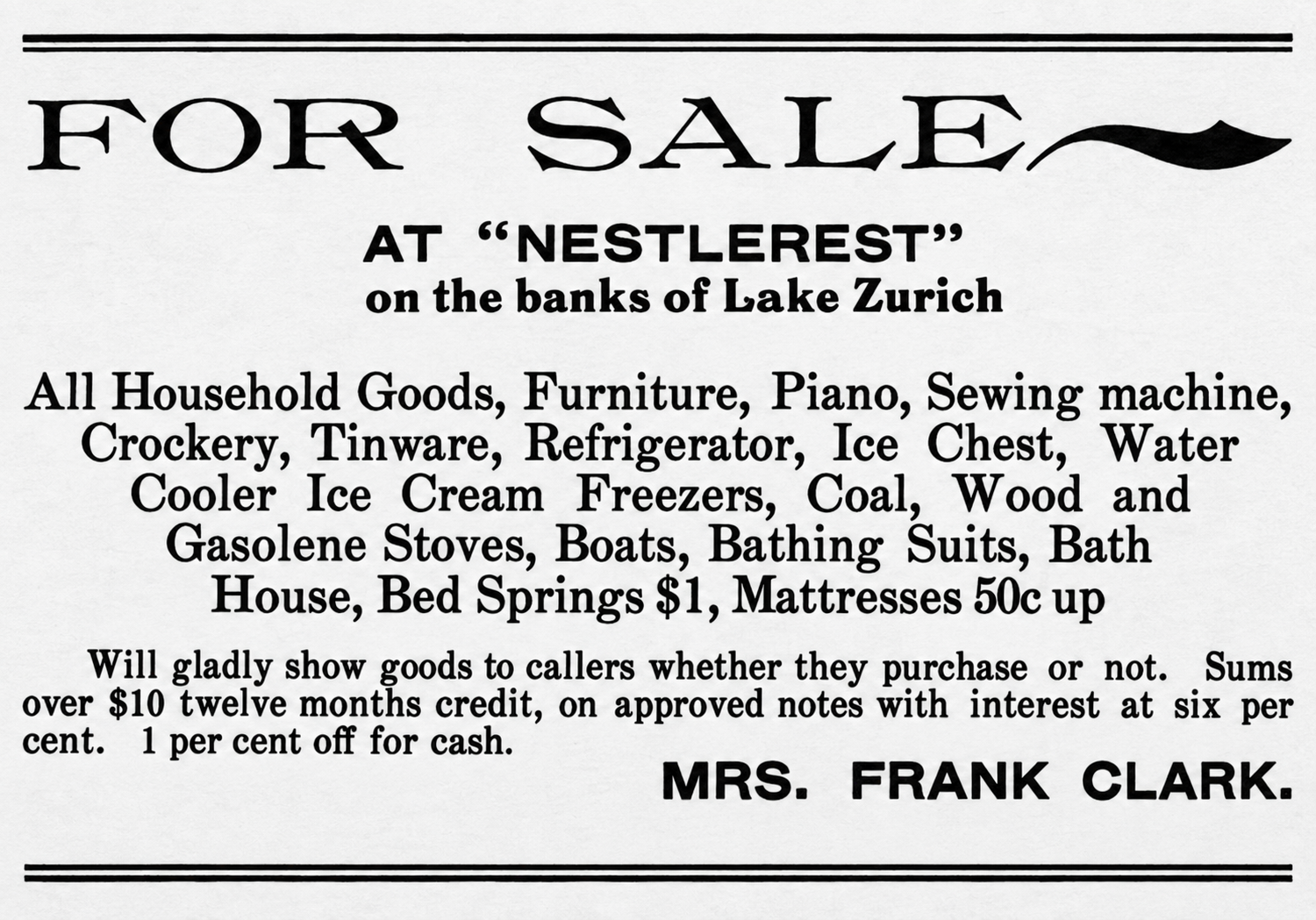
In October 1900, Mrs. Frank Clark placed a sale notice in the Barrington Review advertising property at Nestlerest. The items listed tell the story of the place precisely: household furniture, a piano, domestic goods — and also boats, bathing suits, and a bath house.[12] By the turn of the century, Nestlerest was a named lakeshore home with dedicated boating and swimming infrastructure.
A Resort Comes of Age, 1900–1950
Nestlerest settled into a rhythm that would persist for decades: summer guests from Chicago, families boarding for a week or a season, days on the lake, evenings on the porch. The Palatine, Lake Zurich & Wauconda passenger rail line opened in 1912 and brought city visitors directly to the lake's edge until it closed around 1920–1924. Rand Road was paved in 1922. Each improvement in access brought more visitors.
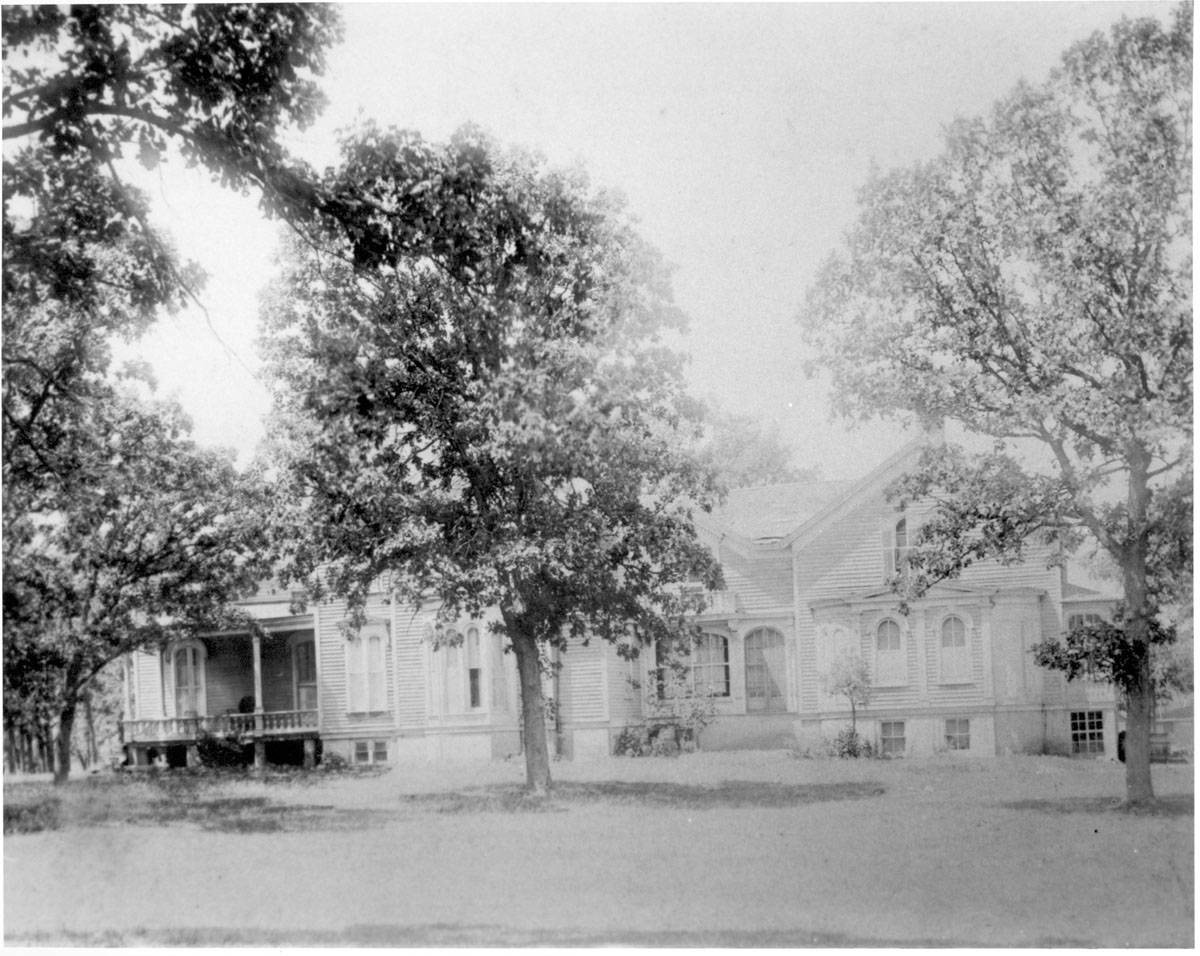
In June 1913, the Chicago publisher C. R. Childs issued a postcard view captioned "Nestlerest on Lake Zurich, Lake Zurich, Ill." — a sign of the property's standing as a recognized destination. The card is now in the collection of the Bess Bower Dunn Museum of Lake County.[13]
By 1928, the Chicago Jewish Sentinel was reporting that families from the North Side were spending entire summers at Nestlerest — the Resnik family of North Kimball Avenue among them.[14] The lake resort culture of the 1920s was flourishing, and Nestlerest was part of it.
In 1936, the property appeared in the newspaper as the "Nestlerest park picnic grove," with public rallies and Sunday picnics advertised there.[15] In 1937 it hosted a Barrington Townsend Club dance with orchestra music.[16] The word "park" had entered the name. The boarding house had grown into something larger.
The Lake Zurich Queen
No feature of Nestlerest was more beloved — or more photographed — than the Lake Zurich Queen, a paddle-wheel showboat moored at the Nestlerest dock. The Queen offered rides on the lake to park guests and became one of the property's signature attractions through the 1960s and 1980s.
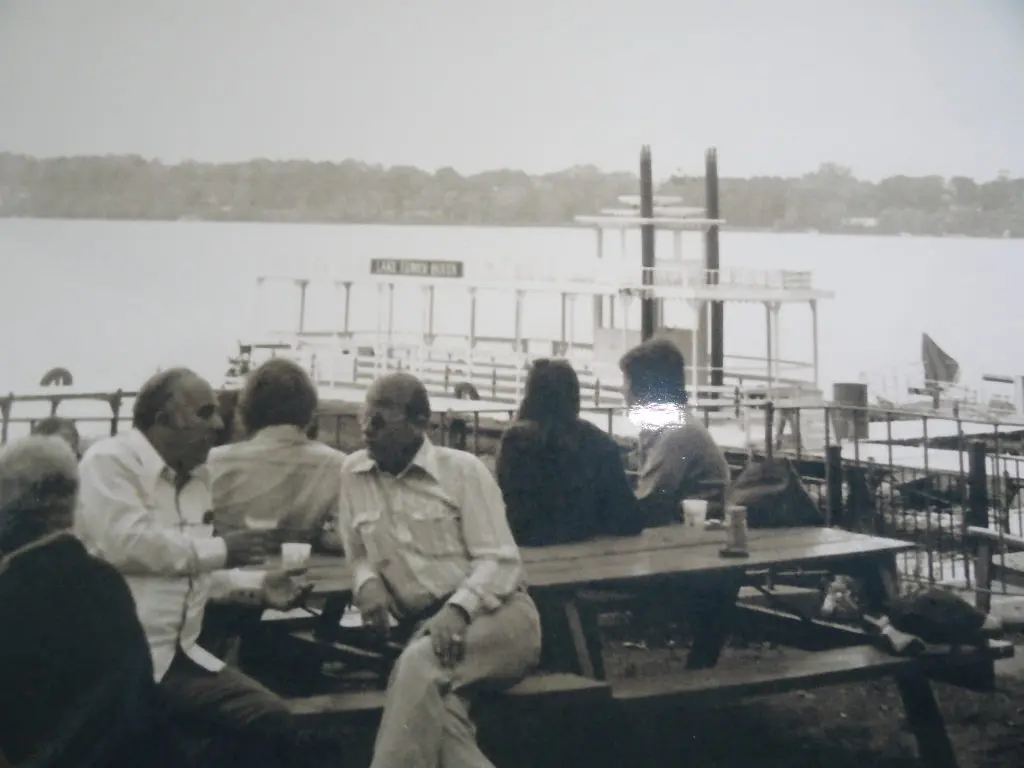
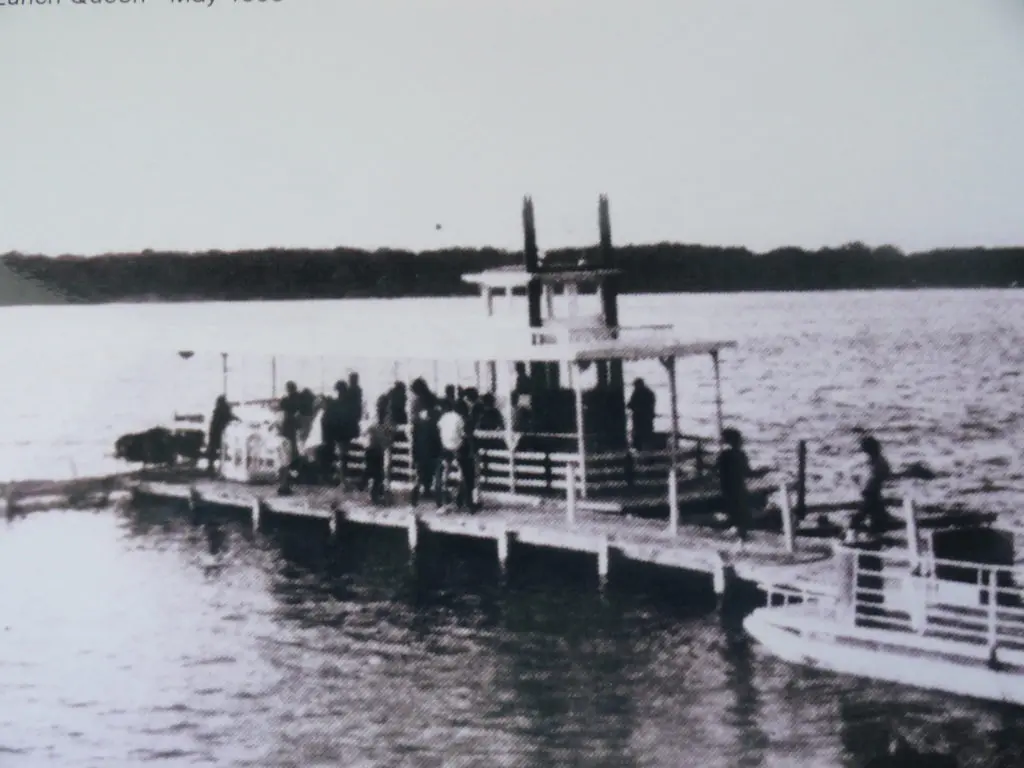
The Ela Historical Society retains a Lake Zurich Queen sign, photographs, and paperwork from the boat's history. The 1993 Illinois Pollution Control Board record lists the "Lake Zurich Queen (Show Boat)" among the park's attractions, alongside the Ferris wheel, whip ride, and putt-putt course.[17] When the park finally closed, a Village record noted a resident thanking staff for getting the Queen removed from the lake and the Nestlerest property cleaned up.
The Corporate Picnic Era, 1951–1986
In 1951, Nestlerest was sold to Richard "Dick" Barrie, who transformed it into a private catering operation serving the corporate summer calendar. According to Ela Historical Society recollections, the park could accommodate parties of up to 2,500 people.[18] Barrie built on what was already there — the historic house, the shoreline, the lake access — and created a destination for Chicago's large employers to bring their workers for a summer day out.
Gary and Lorraine Block moved to Lake Zurich in 1956 to manage Nestlerest Park, and they lived there. Their obituaries record this chapter of Nestlerest's life independently of the local history sources — a corporate picnic park with resident managers, operating through the heart of the postwar boom.[19]
"It was the kind of place where you could host 2,500 people from a single company and have them come back the next summer." Ela Historical Society, "Growing Up in Lake Zurich during the 1940s & 1950s"
The Boado Years, 1986–2004
In 1986, Eduardo P. Boado purchased the property and business, operating it as EPB Park Services. His tenure lasted until 2004 and is documented in unusual detail by a 1993 Illinois Pollution Control Board opinion — Dettlaff v. Boado — arising from noise complaints by neighbors.[17]
By this period Nestlerest occupied approximately 240 feet of Lake Zurich shoreline and 539 feet of Robertson Road frontage. The park layout, as reconstructed from hearing testimony, ran from a putting green, whip ride, and barbecue area near the lake, to a ballfield and parking area toward Robertson Road. The record notes a nearby clown trailer — T-Bone's — a game building, and a picnic area with direct lake access.
The full roster of attractions reflects both the park's mid-century heritage and its gradual updating: the Lake Zurich Queen showboat, putt-putt golf, a Ferris wheel, a whip ride, skill games, a dunk tank, T-Bone's clown act, volleyball courts, a softball diamond, horseshoes, ping-pong, a disc jockey, swings, a teeter-totter, and bingo. About twenty corporate picnics took place each summer, typically with attendance under 1,000. A summer day camp served 80 to 100 children four days a week for eight weeks.[17]
The noise dispute led to modifications. Boado replaced bumper cars with miniature golf, installed a solid cedar fence along the property line, replaced the overhead speaker system with a subterranean one, paved the internal drives, replaced the pier, sound-insulated the game building, and changed components on the whip ride. A prior agreement with the Village had already placed limits on sound levels and operating hours.[17]
Closure, Redevelopment, and Preservation, 2004–2009
The Nestlerest operation ended in 2004. The Lake Zurich Queen was removed from the water. The property was cleared. For several years the old park grounds sat quiet on Robertson Road.
Redevelopment proposals began circulating by 2008. The plan that emerged divided the former 4.69-acre park into eight residential lots while preserving the historic building. At the October 21, 2009 Plan Commission hearing, property attorney Paul Hammer told the commission that the building was thought to have been built in 1859. Architect Ted Basinyek displayed photographs of the existing structure and confirmed that only minor changes were planned: a single support beam, some interior work to meet fire code, and no change to the exterior. The building was approximately 4,900 gross square feet.[20]
The project surveyor, Terry VanAlstine, provided the critical legal bridge at that same hearing. He stated that the resubdivision affected Lots 2, 3, and 14 in Kate W. Goodwin's Subdivision, along with portions of Froelich's Subdivision in the South Shore Subdivision. The name of the Fox family's litigation opponent — Kate W. Goodwin — was still written into the land records, a century after she had placed it there.[20]
What Remains
The Lake Zurich Oaks subdivision was recorded in 2009. Eight R-4 lots were created from the former park acreage. The historic Nestlerest building became 40 Mischa Court, Lot 2 — the only developed lot in the new subdivision at the time of its recording. A 2026 Village planning packet confirms it is still the sole developed lot: a four-unit residential building, likely originally built as a single-family farmhouse, standing on the south shore of Lake Zurich where it has stood since the late 1850s.[21]
The house is not remarkable to look at now — four apartments, a quiet court address, a lakeview that most residents probably take for granted. But the land records beneath it stretch back through eight decades of corporate picnics, a showboat, summer boarding, a renamed cottage, a massive farming estate, a Supreme Court case, and a family that came west from the New York glass country and decided to build something permanent beside the lake.
Related story
Isaac Willard Fox
The farmer, merchant, inventor, and civic figure who built the Lake Zurich estate that would become Nestlerest — and whose name a District 95 elementary school still carries today.
Read the biography →Sources
- George Hale / Hale & Truesdell, Map of Lake County, Illinois (1861). Library of Congress. loc.gov/item/2013593105
- Goodwin v. Fox, 129 U.S. 601 (1889). GovInfo. USREPORTS-129-601.pdf
- 1918 School Histories — Ela Township — Lake Zurich School. Bess Bower Dunn Museum / Illinois Digital Archives. idaillinois.org
- Patch (Lake Zurich), "Patch Passport: Travel Back In Time" (June 10, 2011) — 1865 Fox school-site conveyance. patch.com
- Goodwin v. Fox, 120 U.S. 775 (1887) — names Eleanor Fox as widow and six children. LII / Cornell Law
- Barrington Review, Sept. 19, 1896 — "Lake Zurich's First Village Board"; Harris & Foley ice-house lease from Mrs. Fox. balibrary.org
- Barrington Review, July 7, 1900 — Kate W. Goodwin's Subdivision assessment; July 12, 1907 — same subdivision repeated. 1900 · 1907
- Barrington Review, June 18, 1898 — "The Hermit" under Mrs. F. P. Clark. balibrary.org
- Barrington Review, June 25, 1898 — "The Hermit" renamed "Nestlerest Cottage." balibrary.org
- Barrington Area Library — Special Correspondence Transcription, June 23, 1900 — Nestlerest opened to the public June 15. balibrary.org
- Barrington Review, August 4, 1900 — Nestlerest described as Mrs. Frank Clark's home. balibrary.org
- Barrington Review, October 6, 1900 — Mrs. Frank Clark sale notice at Nestlerest. balibrary.org
- Bess Bower Dunn Museum of Lake County — postcard "Nestlerest on Lake Zurich" #m86.1.571 (C. R. Childs, c. 1913). idaillinois.org
- The Sentinel (Chicago), June 29, 1928, p. 16 — Resnik family summering at Nestlerest. cdm16614.contentdm.oclc.org
- Barrington Review, August 13, 1936 — "Nestlerest park picnic grove." balibrary.org
- Barrington Review, August 5, 1937 — dance at Nestlerest Park. balibrary.org
- Illinois Pollution Control Board, Dettlaff v. Boado, PCB 92-026 (July 1, 1993). pcb.illinois.gov
- Ela Historical Society, "Growing Up in Lake Zurich during the 1940s & 1950s." elahistoricalsociety.com
- Ahlgrim Family Funeral Services — Gerhardt "Gary" Block obituary; Lorraine Block obituary. Gary Block · Lorraine Block
- Village of Lake Zurich Plan Commission Minutes, October 21, 2009. lakezurich.org
- Village of Lake Zurich 2026 Three Acorns / Mischa Court planning packet. lakezurich.org