Debt & the Court
A business account between brothers became a mortgage, then a lawsuit, then a Supreme Court decision — and finally, in 1891, the loss of the farm.
The farm becomes entangled in debt
Mortgages and title disputes came before the famous case. On January 1, 1863, Isaac and Eleanor mortgaged to Samuel H. and Henry W. Fox to secure $15,000, under a bond with a penal sum of $30,000 — a penalty figure, not a second loan.
On February 14, 1866, an agreed judgment in Isaac Willard Fox v. Seth Paine gave Fox possession of the described premises. A separate Paine-family chancery case about a trust, children and land sales followed in 1868. These are earlier complications in the surrounding title, and must not be collapsed into one lawsuit.
The collapse came before the Great Chicago Fire
By about January 1, 1869, according to the Supreme Court's account, Fox was in financial difficulty. First National Bank obtained judgment and execution, goods were seized, and his store closed. That timing matters: the Great Chicago Fire of October 1871 cannot have caused a collapse already documented in early 1869.
On February 20, 1869, Isaac acknowledged a debt of $70,000 to Fox & Co. He transferred merchandise, accounts, fixtures, Chicago real estate — and the Lake Zurich farm — as security. Samuel agreed to reconvey the farm if the remaining debt was paid within six months.
…his farm in Lake County, Illinois, known as the Lake Zurich farm.Agreement of February 20, 1869, as quoted in Goodwin v. Fox, 129 U.S. 601 [S1]
The county deed to Samuel, recorded February 25, 1869 in Volume 43 of Deeds, page 200, states $50,000 and repeats the 535-acre description — reserving, among other things, the one acre for town and school purposes. The $50,000 deed and the $70,000 settlement describe different aspects of one transaction, not competing versions of a cash sale.
More layers followed: Samuel and Emma's 1870 trust deed to Horatio G. Spafford securing $12,000; their 1875 deed to Henry; and Henry and Kate's $12,000 mortgage on 532 acres to Loring Monroe.
Kate Fox, Eleanor Fox and the Supreme Court
Henry W. Fox's death in 1876 brought his wife Kate into the center of Isaac's affairs. Kate was Isaac's sister-in-law — the widow of his brother — not his daughter or widow. Henry's will, probated in Madison County, New York, put his estate under her control. During the litigation she married Charles S. Goodwin, becoming Kate W. Goodwin.
Kate filed suit in federal court on February 17, 1877. The question was not which relative deserved the lake house. The farm secured a disputed business account. Isaac challenged the amount of the debt and sought larger credits for the assets surrendered; Kate's side relied on the written settlement and the money actually realized.
The cost of fighting became another charge on the land: an 1883 trust deed secured $9,000 in legal fees for William C. Goudy and Henry O. McDaid, describing a 15.60-acre lakeshore portion “with buildings and improvements.”
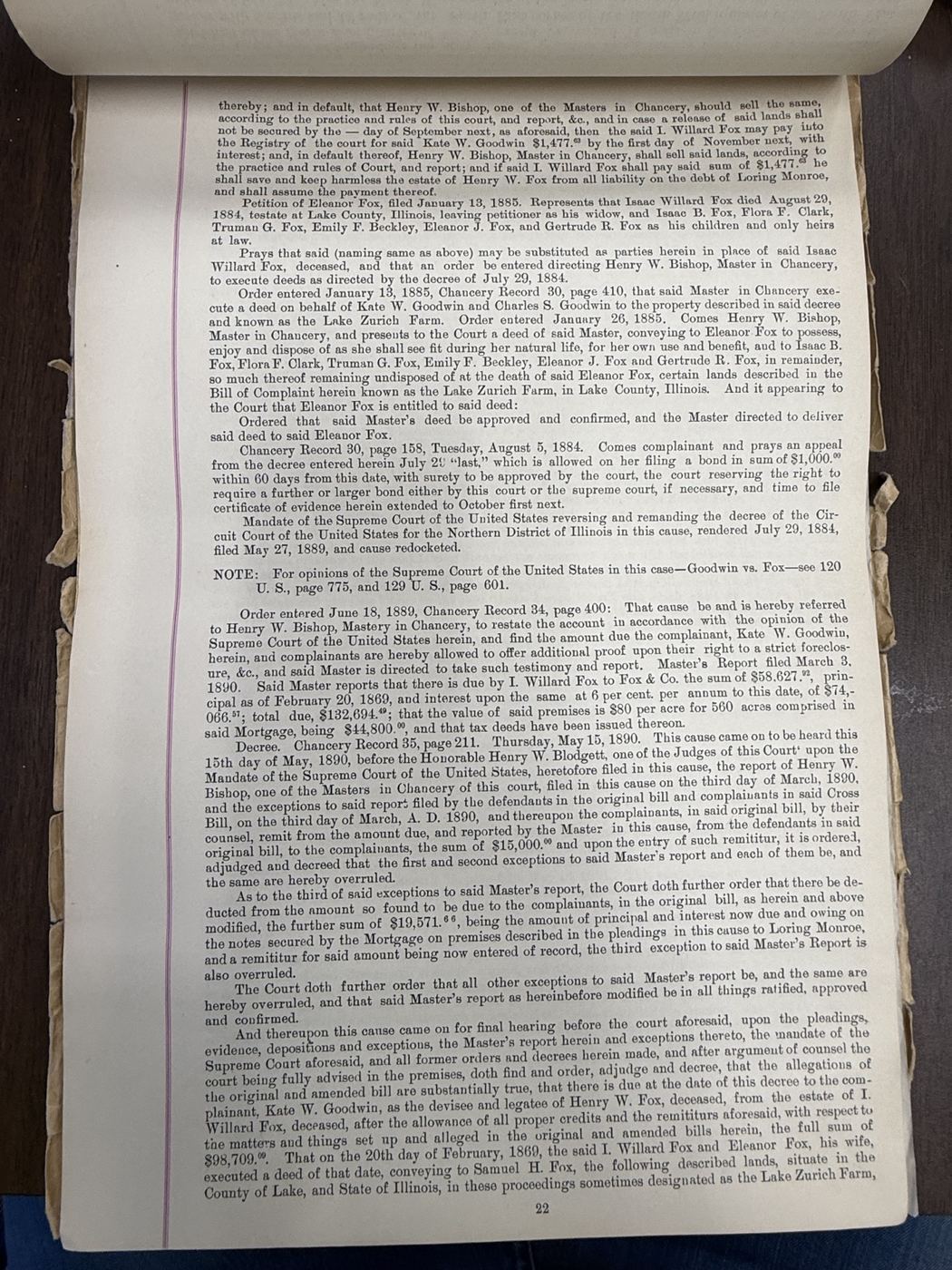
On July 29, 1884 the lower court found a much smaller debt. Isaac died a month later. A master's deed of January 20, 1885 returned the farm to Eleanor for life, with the remainder to the six children. Kate appealed.
On March 5, 1889, the Supreme Court found insufficient proof to set aside the written $70,000 settlement, held that credits should reflect proceeds actually realized, reversed the accounting and remanded the case.
The decisive change: foreclosure became absolute
The concluding pages of the 1891 abstract close the largest gap in the earlier research. The mandate was filed May 27, 1889, and a new accounting ordered. On March 3, 1890 the master reported the figures below.
The decree of May 15, 1890 found $98,709.09 due Kate W. Goodwin after credits and remittiturs, and gave the Fox defendants twelve months to pay with six-percent interest and costs — otherwise strict foreclosure.
On May 16, 1891 the court found that twelve months had elapsed without payment. Eleanor Fox and the six children were barred from their equity of redemption.
Eleven days later, Frank and Flora Clark quitclaimed their interest in the decree property to Kate Goodwin for $1,000. Consolidation is a reasonable reading; the motive is not stated.
The printed figures should not be forced into a simple subtraction without the underlying account. Note the debt decreed was more than twice the master's valuation of the land.
A thread through the house lot
Read in full, the abstract follows one small description through the tax records and the foreclosure: the west half of the southwest quarter of the northwest quarter of Section 20 — the lakeshore strip where the Nestlerest house stands.
At a Waukegan sale on June 6, 1882, a run of Fox lands — “all assessed I. Willard Fox” — was sold for delinquent 1881 taxes. Among them: “the W. ½ of S. W. ¼ N. W. ¼ Sec. 20 … containing 20 acres, to A. V. Smith for $29.97.” A tax deed of June 10, 1884 completed Smith's title.
On December 23, 1887, Ashbel V. Smith quitclaimed his interest in the same half quarter-quarter to Frank P. Clark, Isaac's son-in-law.
And when Frank and Flora Clark quitclaimed to Kate W. Goodwin on May 27, 1891, their deed again named it — “meaning and intending to convey only such part of said premises as is included in the decree rendered in the case of Goodwin vs. Fox.” Flora signed “Flora Fox Clark.” The same deed is copied into a second, unrelated abstract, No. 5482.
So the strip that later became Goodwin's Subdivision was inside the 1890 decree. What the record still does not show is how Eleanor Fox and the Clarks came to be assessed on lots there by 1900.
The chain of title
Step through the recorded conveyances, from federal land entries to the 2009 subdivision. Each stop shows the parties, the record locator, the abstract page itself and a link to its full transcription. Dashed stops mark links that are reported but not yet found in the record.
Back to the federal entries
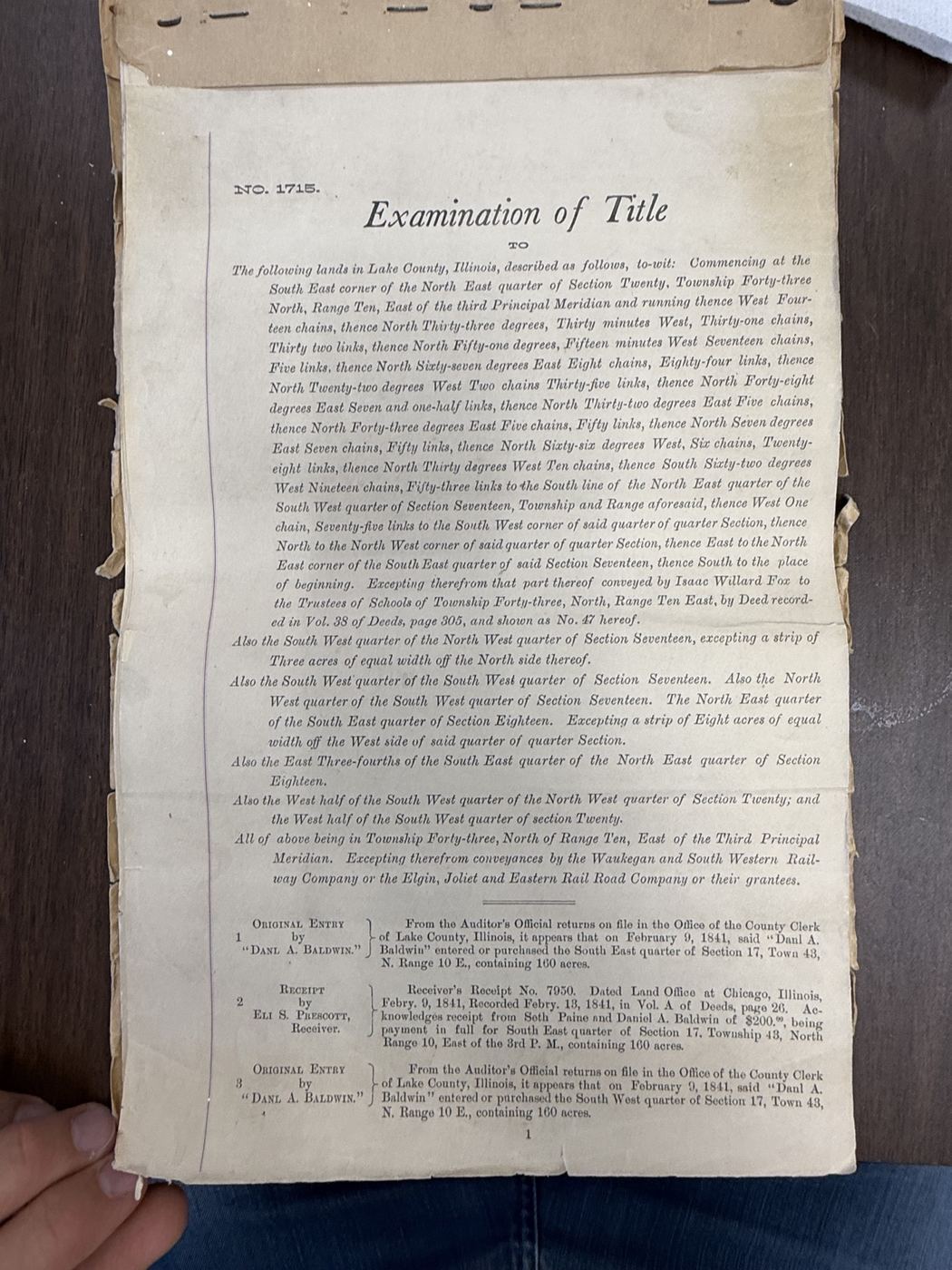
The abstract's first pages distinguish federal land entries and receiver's receipts from patents. Seth Paine entered the southwest quarter of the northwest quarter of Section 20 — forty acres — on February 22, 1841. The price works out at $1.25 an acre; Eli S. Prescott signed as receiver.
Undivided halves passed among Paine, the heirs of Abel Keyes, Marvin McNulty and Baldwin. Daniel A. and Abby Ann Baldwin sold about 535 acres to Charles J. Starr in 1849 for $4,500. Starr sold to I. Willard Fox in 1857 for $8,600.
Next door, Seth Paine tried something stranger. In March 1849 he and Frances deeded north-west-shore land to a group of men “for the purpose of aiding in the establishment of a community on the principle of equal rights & universal brotherhood.” The venture was abandoned, and an 1868 court decree declared the deed void. Paine put his “Lake Zurich property” in trust for his family in 1853; when the trustee, Timothy R. Young, resigned in 1856, Paine took his place, and as trustee he sold part of the land to John Robertson in 1860. The 1868 decree, heard on testimony from Paine, Young and two of the old community men, confirmed it all.
The document is Examination of Title No. 1715, Waukegan Abstract Co., D. L. Jones, manager, certified September 16, 1891 — four months after the foreclosure became absolute. Read the full transcription → · See the photographs →